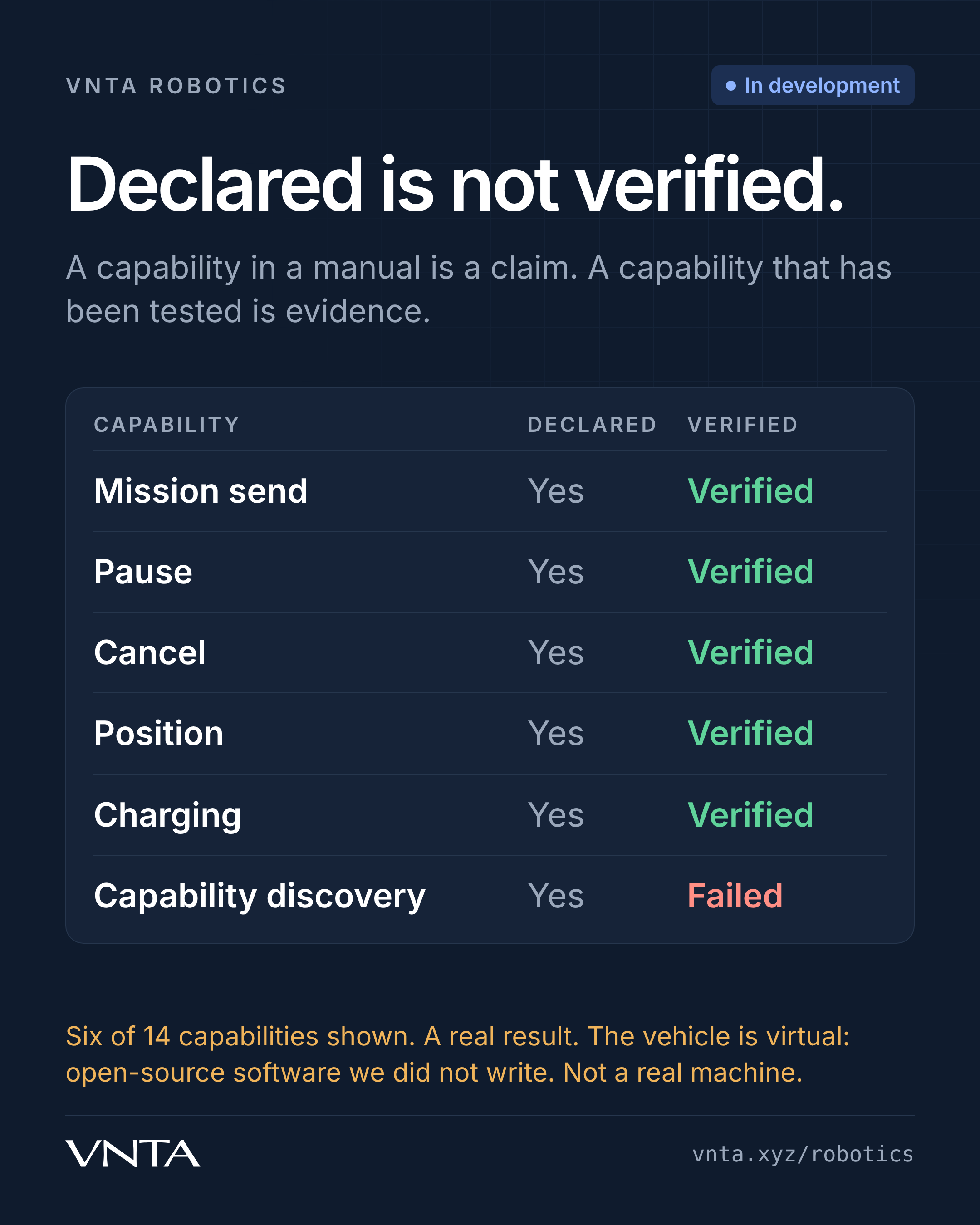
Declared is not verified
A capability in a manual is a claim. A capability that has been tested is evidence.
It is easy to show the first and call it the second.
VNTA Robotics keeps three things apart, for every function of every machine:
Declared: what the interface is documented to offer. Discovered: what the system says when you ask it. Verified: what a test run actually saw work, and when.
The picture is a real result from our console. One virtual vehicle, 14 capabilities, all of them declared. 13 verified. One failed: asked to describe its own functions, it answered, but named none.
It is a virtual vehicle, not a real one. The point is the shape of the answer.
Validation has been tested against simulated systems and one external VDA 5050 implementation. It has not yet been run against a real robot. We are now taking on our first production design partners. VNTA validation evaluates software integration behaviour against a chosen set of checks. It is not a functional-safety certification and does not replace manufacturer commissioning procedures.
Also posted on Bluesky.